What are magnetic powder brakes and servo tension control? Magnetic powder braking and servo torque control are common torque sources in industrial tension control. In roll-to-roll equipment—including printing, slitting, and coating machinery—they manage tension fluctuation caused by roll-diameter change and acceleration or deceleration. A HELISTAR magnetic powder brake combined with an intelligent tension controller can provide stable, no-stick-slip torque output for ultra-thin-material processing or continuous-slip duty with an appropriate total cost of ownership (TCO).
1. The engineering challenge: control the inertia and architecture, not only the tension value
In roll-to-roll processing, slitting, laminating, optical-film, and battery-copper-foil lines, tension control may appear in a specification as a simple figure, such as 20 N or ±3%. The actual engineering problems are usually more complex:
- Changing unwind-roll diameter can cause wrinkles, elongation, or registration error.
- Starting, stopping, acceleration, deceleration, and splice changes can create tension spikes that break thin film or reduce yield.
- Long continuous operation creates heat; without thermal control, braking torque can drift.
The key issue is the torque-producing mechanism and the way the system handles energy, not only the controller setting.
2. Physical mechanism comparison: how is torque produced?
In unwinding, rewinding, and intermediate pull sections, web tension is established through torque at the roll shaft. As an initial relationship:
Tension ≈ Torque / effective radius
This is a first estimate only. Final selection also requires roll inertia, acceleration, friction, transmission efficiency, web path, and control response. For thermal evaluation, record relative slip speed in RPM with torque, duty, and cooling.
Magnetic powder brake vs servo motor torque control
3. System architecture: how the two approaches are built
3.1 Magnetic powder brake: a stable, smooth constant-torque source
A magnetic powder brake is typically installed on the unwind side of a roll-to-roll system. Its engineering role is that torque is highly linear with excitation current, while slip torque remains stable and has no direct relationship with relative speed. It functions as a stable damper with No Stick-Slip behavior.
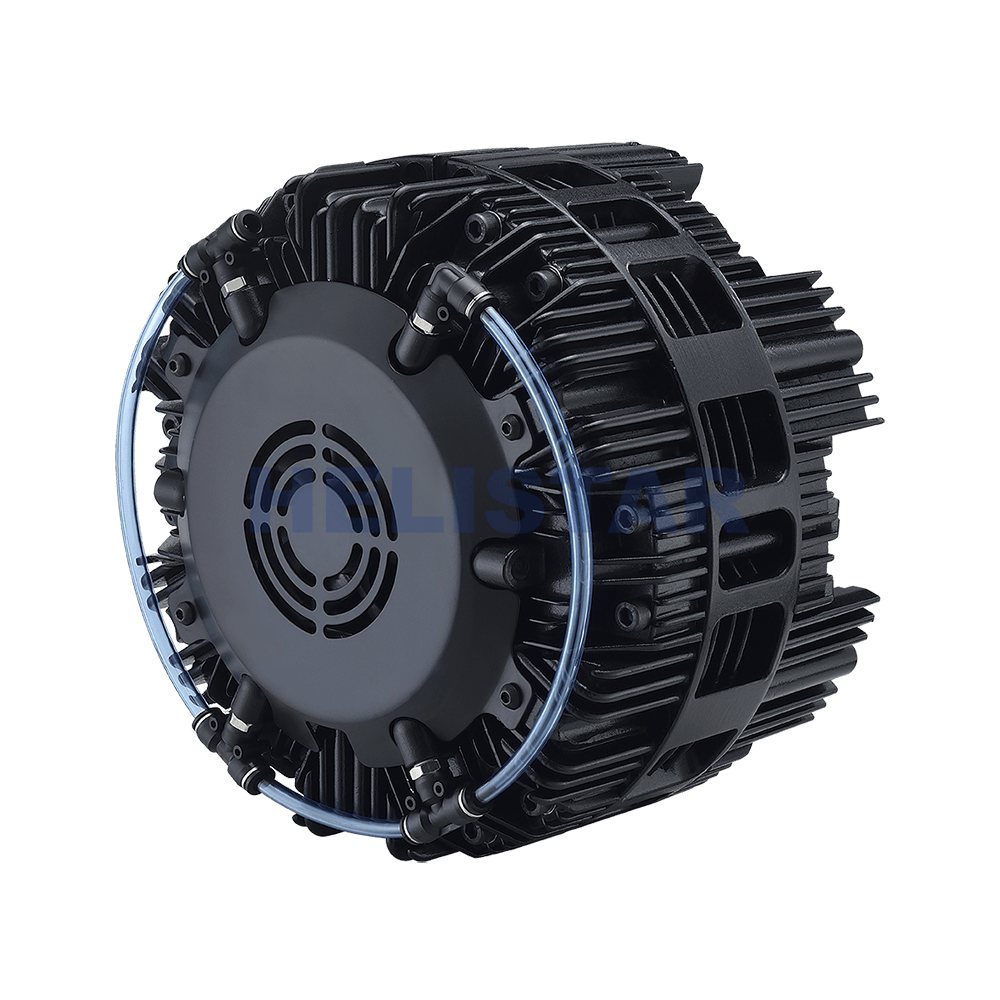
With a HELISTAR PFB axial-fan forced-air-cooled brake and high-temperature alloy magnetic powder, a correctly selected system can handle long-duration, high-heat, continuous-slip processes.
3.2 Servo tension control: a high-dynamic active torque source
A servo motor receives direct torque control from its drive and provides very fast, microsecond-level response together with active driving capability. It operates through an inner drive loop and an outer high-frequency feedback loop from a load cell or dancer.
Where equipment requires zero-speed tension holding or frequent high-speed forward/reverse motion, a servo architecture can provide extreme dynamic performance at higher controls-tuning and integration cost.
4. Five questions that determine the best architecture
- How much start-up tension spike can the process accept? For fragile optical film or copper foil, a magnetic powder brake can provide a buffered, impact-free start; a servo can oscillate if PID tuning is inappropriate.
- What accuracy is required at low speed or zero speed? A HELISTAR PSV-3APS magnetic power supply uses high/low-voltage two-stage constant-current switching for micro-tension. For active positioning while stopped, servo torque mode may be better.
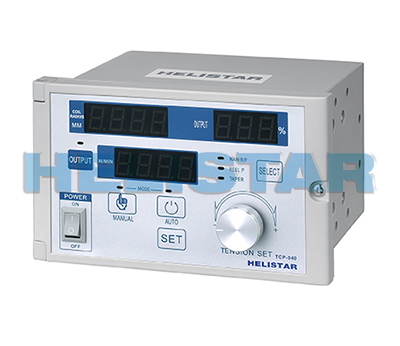
- How will roll-diameter variation be handled? A servo system commonly relies on external PLC diameter calculation. A HELISTAR TCP-040 calculation-type tension controller uses proximity-switch or encoder feedback for one-button diameter calculation and linear compensation.
- How will heat and regenerative energy be managed? Servo systems must size a braking resistor or common DC bus. Magnetic powder systems need thermal margin and, when required, forced cooling.
- Is field maintenance simplicity or complex electrical control the priority? Magnetic powder systems are straightforward to maintain; servo systems rely more heavily on experienced controls engineers for interference and resonance troubleshooting.
5. Common tension-control faults and troubleshooting
Many tension problems are caused by an unsuitable system architecture rather than by a single component. The following table maps common symptoms to possible causes and HELISTAR system directions.
Rather than debating which technology is newer, ask: Which architecture best matches the process requirement and total cost of ownership (TCO)?
Where the process depends heavily on zero-speed tension holding and frequent high-speed forward/reverse motion, a servo system is the first choice. Where the goal is No Stick-Slip behavior, an impact-free compliant start, and a simple, robust architecture for ultra-thin materials such as battery copper foil or optical film, a magnetic powder brake combined with an intelligent tension controller is the best answer for balancing advanced process yield and lower maintenance cost.
💡 Evaluate your tension-control architecture with HELISTAR
If you are evaluating a roll-to-roll tension-control solution, contact the HELISTAR technical team and reference INS-a003. Provide:
- Maximum and minimum roll diameter
- Material type, width, thickness, and target tension range
- Maximum line speed and maximum acceleration
- Any continuous high-heat slip or low-speed micro-tension requirement
With 40+ years' industrial transmission experience, HELISTAR can convert them into a verifiable complete tension-control system solution.
Frequently Asked Questions
Q1. Can magnetic powder brakes and servo tension control be used on the same production line?
Yes. This is a common high-end roll-to-roll configuration that balances performance and TCO. A typical arrangement uses a brake at the unwind station and a servo motor at the rewind station. The brake provides smooth back tension through No Stick-Slip behavior and compliant buffering; the servo provides high-dynamic tracking and active winding.
Q2. Is adding a fan, such as on the PFB series, enough to solve magnetic powder brake slip heat?
For the vast majority of continuous-slip conditions—including slitting, printing, and laminating—the answer is yes. The HELISTAR PFB series uses a dedicated axial-flow fan for forced-air cooling. Together with HELISTAR high-temperature alloy powder, it increases allowable continuous slip power for long-duration, high-heat duty. Only exceptionally high-tension and high-speed conditions require evaluation of water cooling or a servo-regenerative architecture.
Q3. How can I tell whether the magnetic powder in a brake has aged, and does HELISTAR provide overhaul service?
The following symptoms usually indicate that powder has reached its wear life or undergone thermal oxidation:
- Torque decline: braking force becomes noticeably lower at the same excitation current.
- Tension fluctuation: irregular minor sticking, abnormal friction, or unusual operating noise occurs.
In addition to new products, HELISTAR provides professional overhaul service and reverse-engineering support, including internal refurbishment, new high-temperature magnetic powder, and bearing-consumable renewal to restore equipment availability at the lowest practical cost.
Q4. How can a magnetic powder brake maintain automatic constant tension across changing roll diameters?
Pair it with a HELISTAR TCP-040 calculation-type tension controller. There is no need to purchase an expensive high-end PLC or write complex mathematical programs. TCP-040 supports one-button diameter calculation: proximity-switch or encoder feedback calculates parent-roll diameter, and the linear-compensation curve adjusts brake current from full roll to empty roll.