Film feeding instability — showing up as wrinkling, edge wandering, telescoping, or uneven roll hardness — is more common in rewinding and converting operations than most engineers expect. These problems are disruptive, difficult to trace, and often misattributed to the material itself.
In reality, the root cause almost always lies within the rewinding system — specifically in how tension is controlled, how torque is delivered, and how consistently the mechanical components perform.This article walks through the most common causes of unstable film feeding, how to diagnose where the problem originates, and the practical steps engineers can take to restore stable, repeatable film transport.
What Does “Unstable Film Feeding” Mean?
Unstable film feeding refers to a condition where film does not move smoothly or consistently through the machine — even when speed and settings appear unchanged.
Common symptoms include:
• Film wrinkles or creases
• Edge wandering or misalignment
• Telescoping rolls
• Uneven roll density
• Frequent operator intervention
When these symptoms appear together or recur under similar conditions, they are rarely random. They almost always point to tension inconsistency or mechanical imbalance somewhere in the system.
Common Causes of Unstable Film Feeding
Understanding why film feeding becomes unstable is the first step toward fixing it. The causes below are listed in order of how frequently they appear in practice — though in many cases, more than one factor is present at the same time.
1. Inconsistent Web Tension
Fluctuating tension is the single most frequent cause of film feeding instability.
When tension varies — even slightly — film stretches unevenly, friction conditions shift, and the web loses its ability to track consistently through the machine. With thin or sensitive films, even small tension variations are enough to produce visible defects.
2. Poor Torque Stability at Low Speed
Rewinding typically demands high torque at low rotational speeds. If the brake or clutch cannot deliver smooth, consistent torque under these conditions, film feeding becomes jerky and unpredictable.
This is a critical and often overlooked point: torque ripple at low speed translates directly into feeding instability at the film surface.
3. Improper Brake or Clutch Selection
Not all components that meet nominal torque specifications will perform well in practice. Common selection mistakes include:
• Brake torque capacity set too close to operating demand
• Insufficient thermal margin for the duty cycle
• Response characteristics that do not match the application
A component can pass specification checks and still fail to deliver stable film feeding under real production conditions.
4. Mechanical Inconsistencies in the Web Path
Mechanical factors are frequently underestimated as a source of feeding problems. Misaligned guide rollers, worn bearings, uneven roller surface finish, and inconsistent friction across the web width all introduce variability that no tension control system can fully correct.
If the mechanical path is not consistent, instability will persist regardless of control strategy.
5. Diameter Change Without Compensation
As a roll builds, its diameter increases continuously. Without diameter compensation or taper tension control, a constant torque output will produce steadily changing web tension — and feeding stability will deteriorate as the roll grows.
This is a predictable, system-level issue that requires a control-side solution, not a mechanical fix.
How to Diagnose Film Feeding Problems
Not all feeding problems share the same root cause, which means the same fix will not work every time. The checks below help narrow down where instability is actually coming from before any adjustments are made.
Recommended diagnostic checks:
• Does instability increase as roll diameter grows?
• Does tension fluctuate during speed changes or transitions?
• Is low-speed torque smooth, or does the system feel hesitant or jerky?
• Are rollers properly aligned, and do bearings spin freely?
Look for repeatable patterns. Instability that follows a consistent trigger — diameter, speed, temperature — is far easier to resolve than instability that appears random.
Practical Solutions to Stabilize Film Feeding
The following solutions address the most common sources of film feeding instability. In practice, the most effective approach combines control strategy improvements with careful component selection — rather than relying on any single fix.
1. Improve Tension Control Strategy
• Use closed-loop tension control with feedback sensors
• Apply taper tension control to compensate for diameter variation
• Avoid pure constant-torque operation in tension-sensitive applications
In most cases, improving control logic delivers better results than simply increasing brake size.
2. Select Brakes and Clutches with Excellent Low-Speed Stability
For film applications, low-speed torque smoothness is not optional — it is the baseline requirement. Stable magnetic powder brake behavior ensures consistent torque delivery, while predictable thermal characteristics prevent performance drift during long production runs.
The component’s behavior at low speed will define the quality of the film at the unwind station.
Choosing the Right Component for Film Rewinding
Magnetic powder brakes offer a meaningful advantage over conventional friction brakes in film rewinding applications. Their torque output remains smooth and consistent across a wide speed range — including at near-zero speeds, where instability is most likely to develop.
When evaluating components for film rewinding, the key criteria are:
• Low-speed torque smoothness — eliminates micro-jerks that cause wrinkling at the unwind station
• Stable thermal characteristics — prevents torque drift during extended production runs
• Proportional control response — allows precise tension adjustment without overshoot
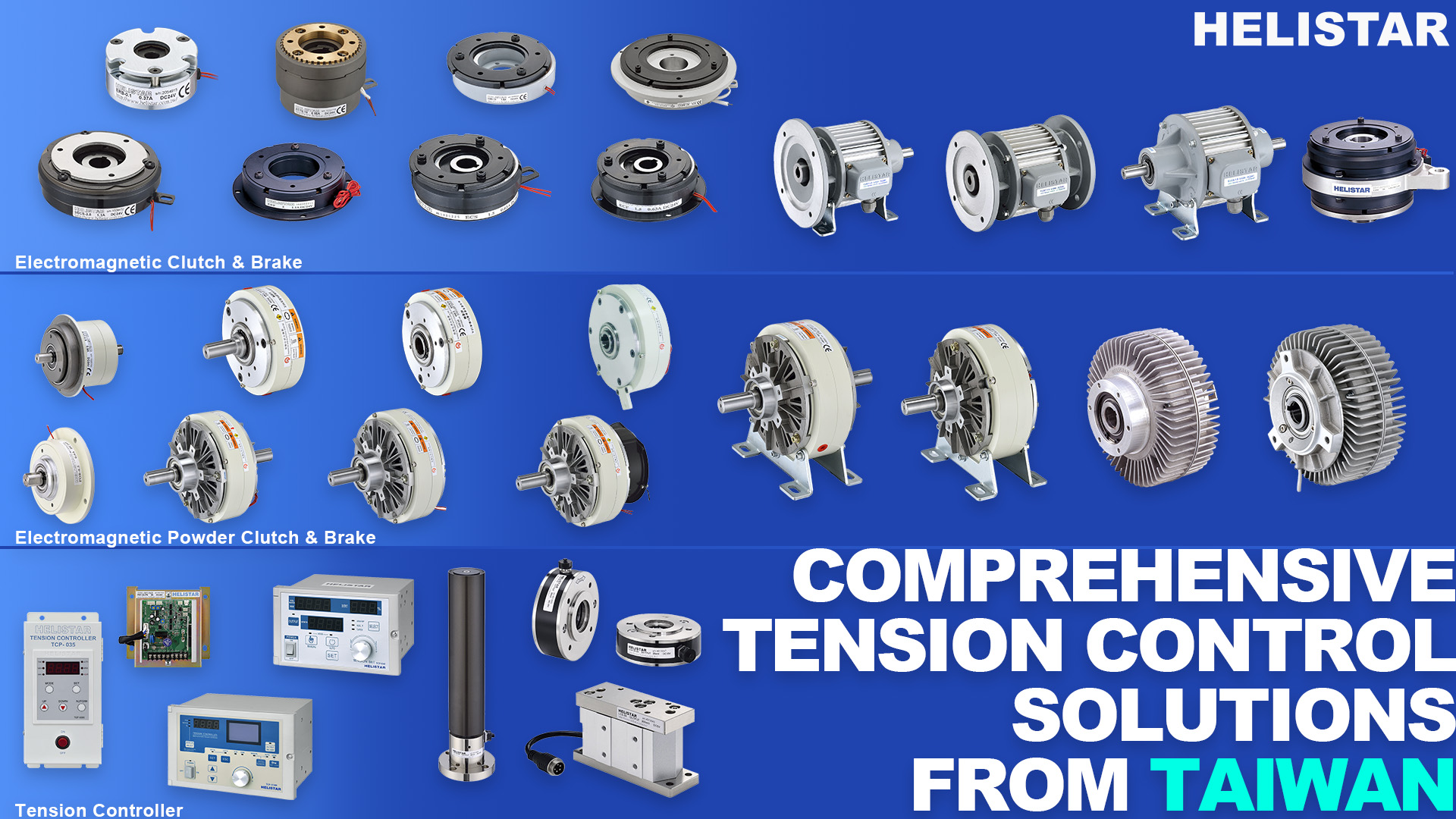
Helistar’s magnetic powder brakes and tension controllers are engineered for exactly these conditions — delivering reliable torque stability in slitter rewinder, coating, and laminating applications where consistent web tension is essential to film quality.
3. Reduce Unnecessary Slip and Speed Variation
• Optimize acceleration and deceleration profiles
• Minimize rapid speed corrections during normal operation
• Avoid excessive slip ratios at the brake or clutch
Smoother system dynamics reduce both tension fluctuation and the surface defects that follow from it.
4. Improve Mechanical Consistency
Ensure rollers are properly aligned, bearings rotate freely, and friction is uniform across the web width. Nip roller parallelism and pressure uniformity also affect film surface quality — uneven nip loading can convert soft wrinkles into permanent creases that no tension adjustment will fix. Mechanical consistency is the foundation on which all tension control depends. Without it, even a well-tuned control system will underperform.
5. Review System-Level Design
If instability persists after addressing the points above, the issue may be systemic. Re-evaluate brake torque margin, review inertia matching between components, and assess overall system dynamics as an integrated whole.
Film feeding problems that resist isolated fixes almost always respond to system-level optimization.
Key Applications for Stable Film Feeding and Tension Control
Unstable film feeding is not limited to one type of machine or industry. The tension control and torque stability principles covered in this article apply across a wide range of web handling applications — each with its own demands on brake selection, controller response, and system design.
Slitter Rewinder
Precise tension control for slitter rewinder applications is critical to consistent slit roll quality and edge accuracy. Rewinder powder clutch selection directly affects how evenly tension is maintained as roll diameter changes — making low-speed torque smoothness a non-negotiable requirement.
Coating Machine
In coating applications, magnetic clutch for coating machine and web tension control performance determine coating weight consistency across the web width. Tension fluctuation at the unwind or rewind station leads to streak defects, uneven coat weight, and increased waste.
Laminating Line
Laminator tension control governs bond uniformity at the nip point. Even small tension variations cause delamination, wrinkling, or registration errors — particularly in multi-layer constructions where each layer has different elastic properties.
Battery Foil Processing
Battery foil tension control and lithium battery tension controller performance are especially critical in electrode manufacturing, where ultra-thin foils have near-zero tolerance for tension variation. Inconsistent feeding at this stage directly affects cell capacity and yield.
Wire and Cable Production
Wire tension control at the rewinding station determines spool density and downstream payoff consistency. Uneven tension during winding leads to tangling, payoff irregularities, and increased scrap rates in downstream processes.
Common Questions About Film Feeding Stability and Tension Control
Q1: What is the most common cause of film wrinkling in a rewinding machine?
Film wrinkling is most commonly caused by inconsistent web tension rather than material defects. When tension fluctuates — due to torque instability, diameter change without compensation, or mechanical misalignment — the film cannot track evenly across the web path, resulting in wrinkles or creases. Addressing the tension control system is typically the most effective first step.
Q2: How does a magnetic powder brake improve film feeding stability?
A magnetic powder brake delivers smooth, proportional torque that can be precisely adjusted via an electrical signal. Unlike friction brakes, it maintains consistent torque output even at very low rotational speeds — a critical requirement in rewinding, where the unwind roll decelerates continuously as diameter decreases. This characteristic directly reduces tension fluctuation and improves film feeding consistency.
Q3: What is taper tension control, and when should it be used?
Taper tension control is a winding strategy where web tension is gradually reduced as roll diameter increases. Without it, applying constant torque to a growing roll produces decreasing tension over time, leading to loose outer layers and quality issues such as telescoping or uneven roll density. Taper tension control is recommended for any application involving sensitive films, foils, or materials where consistent roll hardness is critical.
When implementing taper tension control, the adjustment sequence matters. A practical order that avoids chasing compounding errors:
1. Establish a stable winding mode first — decide whether torque-based or tension-based control fits your material and equipment
2. Set the taper profile — define how tension should reduce as roll diameter increases
3. Fine-tune web tension and lay-on pressure last — only after the taper strategy is stable
Adjusting web tension before the taper profile is defined often creates a moving target: the roll hardness changes as diameter builds, making earlier tension settings appear inconsistent. A magnetic powder brake supports this sequence well because its proportional torque output responds smoothly to the control signal at every point in the taper curve — without the step changes that mechanical brakes can introduce.
Q4: How do I select the right brake for a slitter rewinder application?
Brake selection for a slitter rewinder should account for four key factors: the required torque range across minimum and maximum roll diameters, the operating speed range with particular attention to low-speed performance, the thermal load based on duty cycle and slip speed, and the control method — whether manual, automatic, or closed-loop. A brake that satisfies nominal torque specifications may still underperform if it cannot sustain stable output at low speed or under continuous slip conditions. Application-specific torque calculations should always inform the selection process.
Q5: Can mechanical issues cause film feeding problems even with a good tension control system?
Yes — and this is a common source of frustration. Tension control devices manage torque and tension within the system, but they cannot compensate for mechanical inconsistencies downstream. Misaligned guide rollers, worn bearings, or uneven roller surfaces create localized friction variations that no control algorithm can fully correct. Mechanical inspection should always be part of the diagnostic process when feeding instability persists despite correct control settings.