1) Introduction: At 4.5µm, “Tension” Stops Being a Setpoint and Becomes a System Capability
When copper foil or aluminum foil enters the 4.5µm class, slitting yield is often limited less by knife geometry and more by whether tension can be kept stable—measurably and repeatably. The reason is straightforward: the thinner the foil, the less margin you have against wrinkling, edge cracking, and web wandering. Small disturbances that were once “noise” become defects:
- torque ripple from drives or brakes
- roller runout or eccentricity
- friction coefficient drift (surface condition, contamination, temperature)
- bearing drag variation
- splice/joint events and start/stop ramps
On the same line, with the same recipe, you typically see a narrow and unforgiving window:
- Slightly high tension → edge cracks, web breaks, roll-edge collapse (inner layers bruised or torn)
- Slightly low tension → wrinkles, loose winding, burr amplification, telescoping edges
- Average tension looks normal, but peaks/ripple are high → defects still surge
So the real meaning of tension management in battery foil slitting is not “dial to a number.” It is building an engineered capability: measurable, closed-loop, verifiable, and reproducible tension control.
---
2) Why This Application Requires “Zoning + Closed Loop + Diameter Compensation”
For 4.5µm slitting, tension instability typically comes from three coupled realities.
(1) Roll diameter changes continuously—if torque doesn’t track it, tension will drift
A commonly used engineering approximation is:
\[
T \approx \frac{\tau}{R}
\]
- T: web tension (N)
- τ: shaft torque (N·m)
- R: instantaneous roll radius (m)
Interpretation and why it matters: as R increases, the same torque produces lower tension; as R decreases, tension rises. At 4.5µm, the allowable tension window is narrow, so diameter compensation (estimated or measured) is a requirement, not a “nice-to-have.”
(2) Tension is not a “point”—it’s a chain, and spans/inertia/friction amplify ripple
From unwind to rewind, the web passes idlers, traction sections, the slitting module, and often a nip roller. Each component’s inertia, wrap angle, surface friction, bearing condition, and coaxiality can convert a small speed difference or torque ripple into tension spikes or periodic ripple. Ultra-thin foil is especially sensitive to peak tension, so “good average tension” is not a safety guarantee.
(3) You need functional zoning because each section has different KPIs
A proven approach for 4.5µm slitting is three-zone tension control:
- Unwind zone: resist upstream disturbances (roll eccentricity, splices, friction drift) and stabilize feeding
- Process (slitting) zone: minimize tension fluctuation to protect knife stability and edge quality
- Rewind zone: manage winding tightness and roll-edge quality (compact, no wrinkles, no telescoping)
Without zoning, rewind “tightness” demands can pull up slitting-zone tension, or unwind shocks can propagate into the knife area—driving edge cracks, burr growth, and wrinkles.
---
3) Scenario Mapping: Which Architecture Fits Your 4.5µm Reality?
Below are three common decision scenarios and the associated selection direction.
Scenario A: High speed, strong yield pressure, frequent start/stop and roll changes
Recommended architecture: Active unwind + load-cell closed loop in the process zone + taper tension on rewind
- Active unwind (servo drive/regenerative) helps reduce low-speed stick-slip and start/stop tension spikes
- A process-zone load-cell tension roller provides fast feedback to compress ripple
- Rewind taper tension coordinated with nip pressure helps avoid inner-layer damage and roll-edge collapse
Scenario B: Existing line is mainly brake-driven unwind; improvement is needed without major rebuild
Direction: you may not need a full redesign—but you must define specifications clearly and clean up the signal path
- If unwind uses a magnetic powder brake/brake unit, verify: usable linear torque range, thermal capacity, low-speed stability, and torque drift with temperature
- Add an isolation section (dancer arm or S-wrap isolation roller group) to reduce upstream disturbance transmission
- In practice, grounding/shielding, sampling rate, and filtering strategy are often the “invisible but most critical” upgrades—because unstable measurement becomes unstable control
Scenario C: Roll-edge defects dominate (telescoping, flared edges, inner-loose/outer-tight) more than wrinkles or edge cracks
Focus: rewind roll build is not solved by tension alone
- Tension + nip pressure + diameter compensation (including taper curve) must work together
- Increasing tension alone may improve the outer layers while bruising the core; increasing nip alone can “seal in” micro-wrinkles into permanent creases
- Build a recipe where roll diameter is the independent variable to achieve reproducibility
---
4) Key Selection Criteria & Specifications (So Tension Is Controllable and Auditable)
The following items are practical to write directly into purchasing specifications or retrofit requirement documents—so the machine not only “runs,” but also scales to stable production.
4.1 Tension zones and isolation capability
- Zone count: at minimum unwind / process / rewind (three zones)
- Isolation elements: dancer, S-wrap, isolation roller group—installed for decoupling, not for appearance
- Sensing points: the process zone should have independent tension feedback; do not rely only on rewind-side tension as a proxy
4.2 Tension measurement choice: load cell vs dancer
Load cell (tension roller)
- fast response, high potential bandwidth
- best suited to compress process-zone fluctuation
- sensitive to installation parallelism, bearing drag, and zero drift
Dancer
- provides buffering/decoupling and is friendly to sudden disturbances
- can introduce mechanical resonance and hysteresis; poor tuning can create low-frequency oscillation
Practical recommendation for 4.5µm: use load-cell feedback around the knife entry/exit as the core method for stability. If you use a dancer for isolation, consider whether the critical section still needs load-cell measurement so performance remains measurable and verifiable.
4.3 Drive/brake selection: torque smoothness matters more than “max torque”
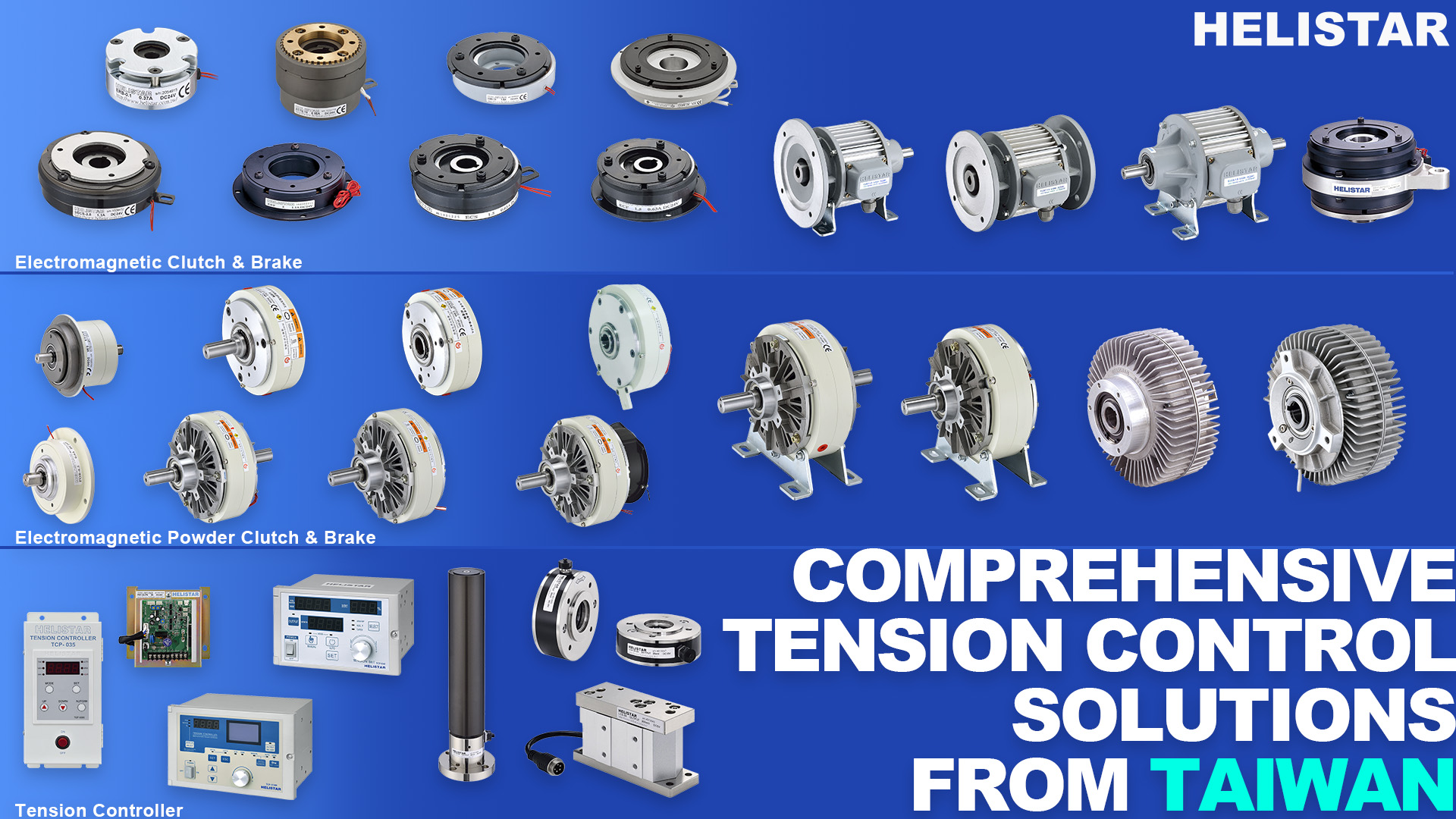
- For passive unwind braking, magnetic powder brakes are common and simple, but you must control temperature-related torque drift, low-speed stick-slip, and torque ripple
- For certain architectures that require slip/differential behavior or smooth micro-tension regulation, a magnetic powder clutch may be used for torque modulation/isolation (depending on machine layout)
- For motor closed-loop solutions, evaluate drive current-loop performance, speed-loop stiffness, and torque-ripple suppression—not just nameplate power
Key point: at 4.5µm, you are not rewarded for “more force.” You are rewarded for smaller fluctuation. Torque smoothness and control resolution often decide yield more than peak torque.
4.4 Roll diameter estimation and taper tension (taper curve)
- Diameter estimation: calculated from line speed and shaft speed, or corrected by a diameter sensor (laser/ultrasonic)
- Taper tension: as diameter increases, tension is gradually reduced to avoid inner-layer bruising and roll-edge collapse
- Recipe-based control: map material, thickness, line speed, and target roll-edge quality into repeatable curve parameters
---
5) Common Mistakes, Cautions, and Field Notes (Where 4.5µm Projects Most Often Fail)
Mistake 1: Looking only at average tension, ignoring peaks and frequency characteristics
A common 4.5µm failure mode is “average OK, edge cracks caused by transient peaks.” At minimum, record and review:
- steady-state peak-to-peak tension ripple
- tension spikes during acceleration/deceleration
- tension response when a splice/joint passes through
Mistake 2: Assuming “closed loop” is finished once a sensor is installed
Closed-loop stability depends on more than having a load cell:
- sampling rate and filtering must be appropriate (avoid phase delay that causes oscillation)
- periodic components from roller eccentricity must be identified (and avoided or suppressed if needed)
- shielding, differential input, and single-point grounding must be consistent—otherwise tension “appears to jump”
Mistake 3: Speed loop and tension loop fighting each other (unclear master/slave roles)
A common architecture is traction roller as master speed, with unwind/rewind as tension (torque) slaves. If the speed loop is too stiff or acceleration ramps are too aggressive, tension peaks are unavoidable. Practical actions:
- define master speed vs tension slave clearly
- enforce acceleration/deceleration slope limits—especially around splices and roll changes
Mistake 4: Fixing roll-edge issues by only increasing tension or only increasing nip
Telescoping and flared edges are often a combined effect of tension curve + nip pressure + small differential-speed drift. Over-increasing tension may “clean up” roll edges short term but raises edge-crack risk and inner-layer damage. Solve it with taper tension + nip curve + diameter compensation together.
---
6) A Workable Implementation Path: From Commissioning to Acceptance, With Auditability
6.1 Recommended commissioning sequence (to avoid “tuning into chaos”)
- Mechanics first: roller runout, parallelism, bearing drag, wrap angles, surface condition/friction
- Control next: speed-loop stiffness, torque limits, sampling/filtering, diameter compensation
- Process last: process-zone tension window, rewind taper curve, nip curve, acceleration/deceleration curve
6.2 Acceptance terms worth specifying (high leverage for procurement and projects)
- representative material: 4.5µm copper foil or aluminum foil, continuous run at target line speed for a specified duration
- provide tension trend data: store raw samples and filtered signals for comparison and traceability
- roll-edge quality measurement: edge height difference, flaring, telescoping ratio
- reproducibility: after roll change or shift change, the recipe can restore the same quality (recipe reproducibility)
These criteria move evaluation from “the line can run” to “the line can mass-produce with repeatable quality.”