A common reality on slitting and laminating lines is that the faster you push the machine, the more likely you are to see wrinkles, web wandering, registration drift, edge defects, baggy edges, telescoping, and even web breaks. In many plants, these symptoms look different—yet they repeatedly trace back to the same root cause: tension is not consistent between unwind, traction/process zones, the lamination point, and rewind, and there is no repeatable way to control it.
From an engineering perspective, fixing tension is not simply “increase/decrease tension.” You need to answer three practical questions:
- Where is the tension variation happening—unwind, process, or rewind? (zoning)
- Is tension being “held by friction,” or truly “controlled with feedback”? (control architecture)
- As roll diameter changes, how will torque be compensated—especially near end-of-roll? (diameter effect + taper)
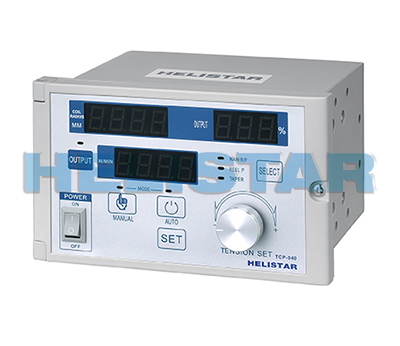
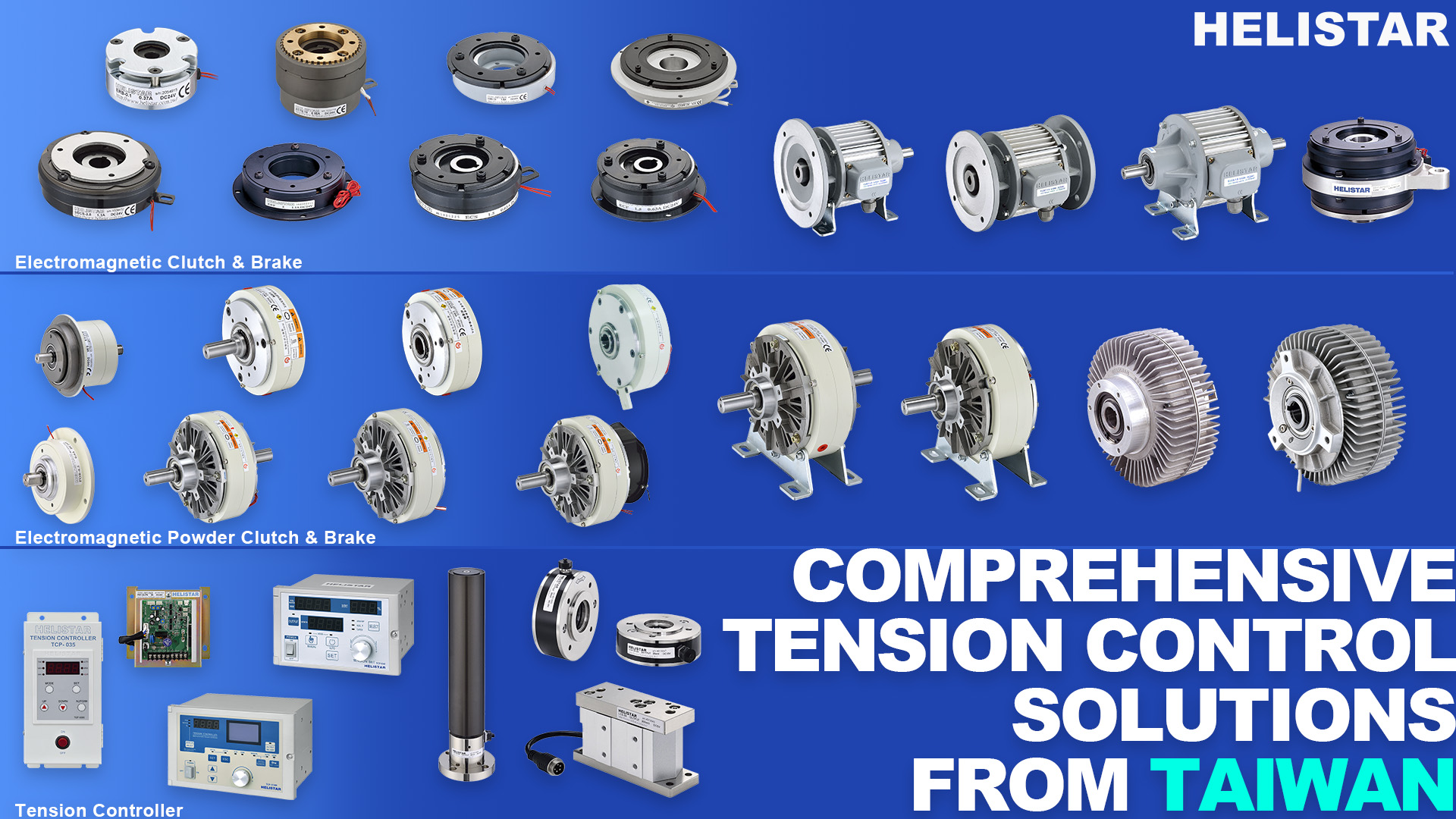
This article focuses on a widely used, production-proven approach: HELISTAR PLB / PFB magnetic powder brakes paired with a TCP tension controller, implemented with feedback (load cell or dancer) to create a stable, scalable tension system—often without a major mechanical redesign.
---
1) Why this solution fits slitting and laminating (Powder brake + TCP tension controller)
At the unwind, “stable tension” means converting the web’s pulling force into a controlled counter-torque. For many slitting/laminating machines, the most practical and easiest-to-integrate method is:
- Install a magnetic powder brake (PLB / PFB) on the unwind shaft to provide smooth, adjustable braking torque
- Use a TCP tension controller to regulate brake current based on feedback (load cell or dancer), creating closed-loop (or semi-closed-loop) control
This combination delivers several advantages that matter on real converting lines:
- Smooth torque and stable behavior at low speed
Thin films, foils, tapes, and sensitive laminations often fail during crawling speeds, threading, or ramping. Powder brakes provide stable torque where many friction-based methods become inconsistent.
- Easier implementation of tension taper (Taper) and event compensation
As unwind diameter decreases, tension tends to rise if braking strategy is not adjusted. A TCP controller can apply diameter compensation and “recipe-like” settings so tension remains controllable throughout the roll.
- High impact without replacing the main drive
Many upgrades can stabilize quality by improving the unwind tension loop first—adding a powder brake and feedback—without rebuilding the entire machine drive system.
Key reminder: In slitting/laminating, yield losses are often caused not by the average tension being wrong, but by tension fluctuation and zone-to-zone interference. The value of this solution is that it becomes measurable, zoned, and recipe-driven.
---
2) Scenario mapping: which machine section is most likely causing defects?
Use the defect pattern to quickly locate the tension zone most likely responsible.
Scenario A: Wrinkles after lamination, registration drift
- Typical materials: PET/OPP/CPP/PI films; multi-layer laminations
- Common root cause: tension mismatch before/after the lamination point; upstream unwind fluctuation causes elastic stretch and recovery
- Engineering direction: build a stable tension zone before the nip; for multi-web laminating, consider independent unwind feedback per layer
Scenario B: Foil slitting shows edge cracking and higher burr/edge defects
- Typical materials: aluminum foil, copper foil
- Common root cause: tension spikes before the knives; acceleration overshoot; tension differences before/after slitting that “pull” the material into failure
- Engineering direction: closed-loop unwind plus accel/decel tension limits; establish a stable tension band before slitting
Scenario C: Telescoping, inconsistent roll hardness (loose/tight roll variation)
- Typical materials: films, paper, nonwovens, tapes
- Common root cause: rewind tension without proper taper; poor coupling between nip load and tension; feedback delay or poor signal quality
- Engineering direction: rewind closed-loop + Taper settings; verify sensor installation, alignment, and signal filtering
---
3) Which control level do you need: open-loop torque, dancer, or load cell?
You do not always need the “highest-end” approach—what you need is the right control level for the process sensitivity. The three most common methods are:
(1) Open-loop torque control (no true tension feedback)
- How it works: the controller outputs a fixed current/torque, sometimes with simplified compensation based on speed or estimated diameter
- Advantages: low cost, fast retrofit
- Risks: friction changes, roller contamination, and roll-to-roll variation directly become tension drift
- Best fit: low speed, larger allowable tension error, or temporary improvement steps
(2) Dancer feedback (position-based closed-loop)
- How it works: dancer position reflects tension changes; the TCP controller adjusts brake torque to maintain dancer position
- Advantages: buffers sudden disturbances; more forgiving during splices and transient events
- Notes: response and stability depend heavily on dancer inertia, spring/air settings, and mechanical friction
- Best fit: elastic materials and lines with frequent events (splicing, frequent ramping)
(3) Load cell feedback (direct tension measurement)
- How it works: load cell measures web tension directly; TCP controller closes the loop by controlling brake torque
- Advantages: measurable and traceable tension; repeatable “recipes”; best for yield and cross-batch consistency
- Notes: correct force direction, machine rigidity, and noise handling are critical
- Best fit: high-speed slitting/laminating and sensitive films/foils where tension peaks and drift immediately affect quality
---
4) Key selection and setup criteria: turning “controllable tension” into engineering parameters
4.1 One simple relationship that prevents end-of-roll surprises
In unwind/rewind systems, tension is commonly understood with:
T ≈ τ / R
Where T is tension, τ is torque, and R is roll radius.
Plain meaning: with the same braking torque, tension increases as the roll gets smaller.
That is why end-of-roll is where tension “floats up” most easily—leading to wrinkles or breaks on thin webs—unless you apply diameter compensation, feedback control, and sensible accel/decel limits.
4.2 PLB / PFB magnetic powder brake selection checklist
When specifying PLB / PFB for a powder brake for slitter machine application, focus on the factors that determine stability over time:
- Torque range (with margin): cover the operating requirement from max diameter start to min diameter end, with safety margin to avoid continuous near-limit operation (thermal drift risk).
- Thermal capacity and cooling conditions: unwind braking is a heat load. Evaluate continuous power dissipation, ventilation, mounting space, and duty cycle.
- Mounting style and shaft-line compatibility: shaft diameter, keyway/flange, concentricity, and bearing support must meet mechanical tolerances to prevent vibration/runout-induced tension variation.
4.3 TCP tension controller setup points engineers adjust most often
For reliable production (not just a good “demo run”), these settings typically decide success:
- Setpoint and material window: define a usable tension range first; for films and foils, prioritize avoiding peaks/overshoot.
- Filtering and feedback gain: excessive gain can cause oscillation; incorrect filtering can create feedback delay—hurting roll build and knife stability.
- Accel/decel compensation: acceleration, emergency stop, splicing, and roll changes are major sources of tension peaks; treat these “events” as part of the recipe.
- Taper (Taper) strategy: commonly used on rewind (and sometimes on unwind depending on material). The goal is consistent roll formation—tight enough to be stable, but not so tight that it crushes, blocks, or slips.
---
5) Common mistakes and practical cautions (to avoid costly trial-and-error)
- Only watching the tension number, not the tension zones
With a single measurement point, disturbances are hard to trace. In practice, separate at least unwind / process / rewind zones, and use a traction nip (or driven roller) as an isolation boundary.
- Blaming all wandering on tension while ignoring micro-slip and mechanical error
Low nip pressure, insufficient wrap angle, poor roller concentricity, and uneven bearing drag can make the reading look stable while the web still slips.
- Waiting until end-of-roll breaks happen before tuning
End-of-roll breaks are often the diameter effect plus insufficient compensation. If you use a powder brake, verify diameter compensation/feedback strategy and set accel/decel tension limits.
- Ignoring dust/adhesive contamination effects on friction
Changes in web-path friction directly impact tension stability and feedback behavior. Cleaning practices, roller surface condition, and wrap angle design should be considered part of the control system.
- No recipe management—depending on “operator feel”
If every change in material width/thickness/speed forces a re-tune, your parameters are not engineered. Organize tension, taper, event compensation, and nip settings into recipes to make yield repeatable.
---
6) Recommended implementation path: stabilize unwind first, then extend to process and rewind
If your goal is to quickly reduce wrinkles, breaks, and wandering, the highest-impact sequence on many lines is:
- Unwind: implement PLB / PFB magnetic powder brake + TCP tension controller + feedback (load cell or dancer) to suppress tension fluctuation first
- Process section: use traction nips/driven rollers to isolate tension zones, preventing lamination and slitting from disturbing upstream tension
- Rewind: add Taper and roll-build strategy to eliminate telescoping and inconsistent roll hardness