For flexo, gravure, and label printing lines, the biggest risk is rarely “the machine won’t run”—it’s unstable web tension. Once tension drifts, problems immediately show up as registration error, wrinkles, edge wave, die-cut misalignment, and inconsistent rewind tightness. The result is higher scrap rates and more downtime for re-tuning.
In unwind tension control (and in some rewind architectures), magnetic powder brakes remain a mainstream solution because they provide continuously adjustable torque, stable low-speed behavior, and a mature control ecosystem. This article is written for engineering selection and integration: how flexo/gravure/label needs differ, how to size torque and manage heat, how to integrate with tension controllers, and what mistakes most often cause “it installs fine, but tension won’t stabilize.”
---
1) Why Magnetic Powder Brakes Fit Printing Applications
Unwind tension control is essentially a fight against one constant disturbance: roll diameter keeps changing. The same target tension requires different braking torque as the radius grows or shrinks. Magnetic powder brakes match this reality well:
- Smooth, continuous torque adjustment: torque is controlled via excitation current that changes the powder coupling condition, so tuning is intuitive and stable.
- Stable damping at low speed / jog: during threading, alignment, plate change, cleaning, or crawl-speed checks, the web still must not go slack or wrinkle.
- Mature closed-loop integration: easily paired with a tension controller and feedback from load cells or a dancer roller, reducing sensitivity to diameter changes and disturbances.
One practical engineering relationship (the only formula in this article)
T ≈ F × R
- T = required brake torque
- F = target web tension force
- R = current roll radius
Plain meaning: higher tension and larger roll diameter require higher braking torque. For unwind selection, engineers typically estimate maximum required torque at the maximum roll radius to avoid the common failure mode: “tension can’t be achieved when starting from a full roll.”
---
2) Flexo vs. Gravure vs. Label: Different Tension Zones, Different Priorities
These processes all print webs, but differences in speed, environment, and multi-zone layouts change what matters most in brake selection.
2.1 Flexo (Flexographic): low tension fluctuation to protect registration
- Common substrates: films, paper, laminates; frequent material changes.
- Key requirement: tension stability and low-speed controllability to prevent registration drift and wrinkling.
- Typical recommendation: unwind powder brake + tension feedback (load cell or dancer) + tension controller. If your controller supports recipe management, changeovers become faster and more repeatable.
2.2 Gravure: long high-speed runs—heat management becomes critical
- Typical reality: high speed, long continuous production; ovens and solvent environments are common.
- Key requirement: powder brakes can generate heat under slip—gravure often needs:
- higher heat dissipation / thermal capacity
- more stable torque consistency to avoid thermal fade that lowers tension
- Practical approach: plan airflow, mounting position (avoid hot zones), and derating strategy during early design—don’t treat heat as an afterthought.
2.3 Label (Narrow-web): multi-zone tension with low-tension resolution and dynamic response
- Typical processes: laminating, die-cutting, matrix stripping, slitting, rewinding—many zones, many setpoints.
- Key requirement:
- low-tension controllability (a common pain point)
- fine control at small diameters to avoid elongation and positioning errors
- Practical approach: use closed-loop on unwind and critical zones first. If rewind also uses a powder solution, ensure diameter estimation/compensation and disciplined parameter management.
---
3) Scenario Mapping: Where Powder Brakes Make the Most Sense on a Printing Machine
The table below simplifies typical module-level decisions for quick alignment across mechanical, electrical, and process teams.
> This guide focuses on magnetic powder brakes. If your line speed is extremely high or you have strong energy-saving/regeneration requirements, you may also evaluate servo tension or regenerative braking architectures—but you will still need a clear tension-zone design and a reliable measurement strategy.
---
4) Key Selection Criteria (Ask These Once, Select Once)
4.1 Torque range: size for max diameter, then confirm low-torque controllability
- Maximum torque typically occurs at maximum roll diameter while meeting the target tension.
- Low-torque controllability determines whether small diameter / low tension operation becomes “tight-loose-tight,” which is especially sensitive for label stock and thin films.
Practical sizing guidance for tunability and life:
- Keep normal operating torque around 30%–70% of rated torque to balance resolution and thermal margin.
- If you often jog, run at low speed, or have frequent accel/decel cycles, prioritize stronger heat dissipation and more margin.
4.2 Heat dissipation and thermal fade: don’t only ask “is torque enough?”—ask “for how long?”
Heat is created by slip power. Printing lines commonly face higher thermal risk when:
- running high speed continuously
- holding braking for long periods (high slip work)
- frequent start/stop and acceleration cycles (energy repeatedly turns into heat)
Mitigation should be considered in both selection and machine design:
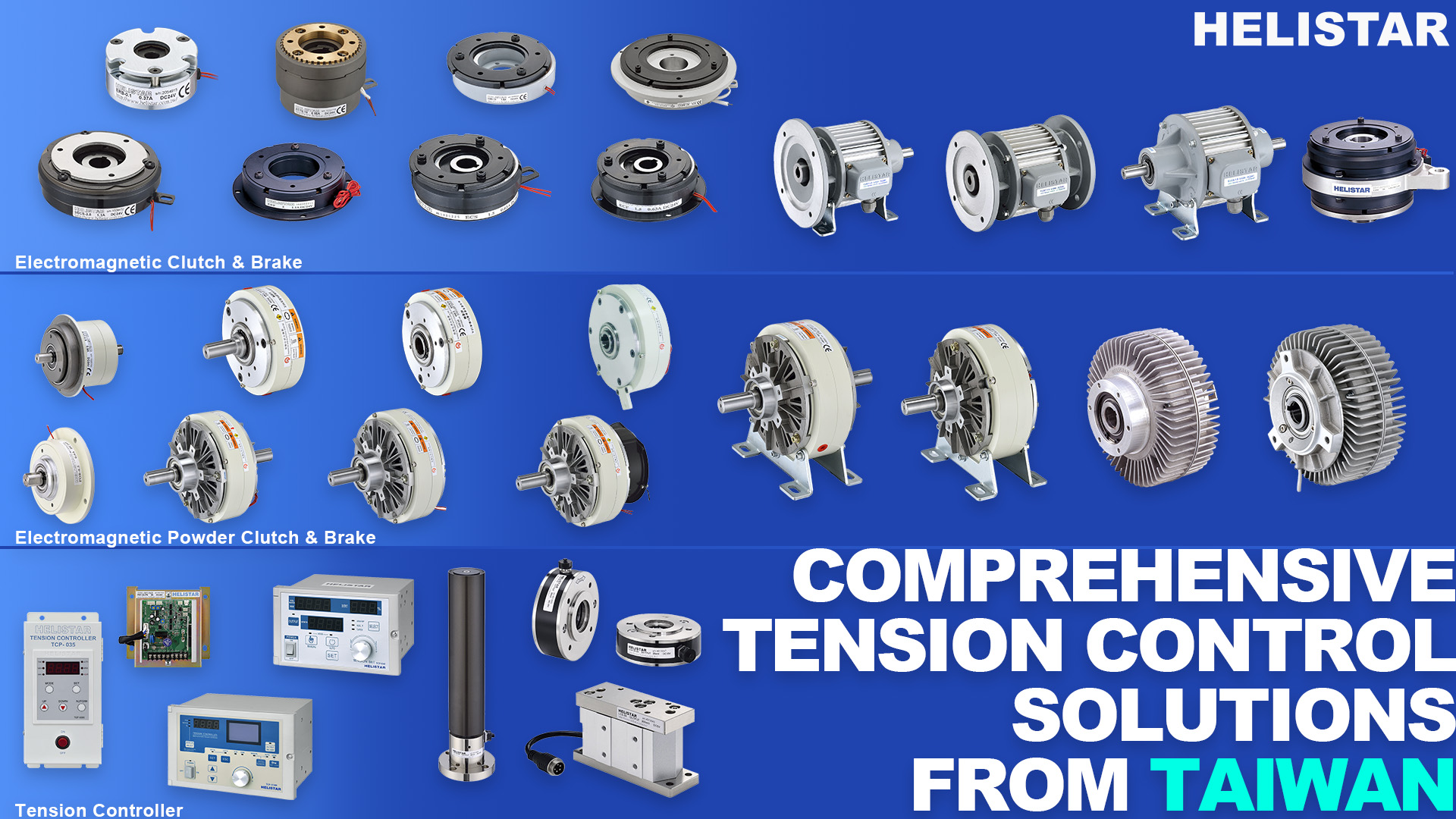
- When selecting HELISTAR PLB / PLBS for printing tension control, evaluate the heat dissipation structure and mounting location
- Reserve space for airflow or forced ventilation
- In the controller, use start/stop ramps, tension limits, and—when the system allows—derating strategies
4.3 Control method: open-loop can run; closed-loop runs stable (recommended for main printing webs)
Two common control logics:
- Open-loop (current → torque)
- Pros: simple architecture, lower cost, straightforward adjustment
- Risks: diameter change, friction variation, and temperature rise cause tension drift
- Best for: non-critical zones or applications with wide tension tolerance
- Closed-loop (tension feedback → control output)
- Pros: compensates for diameter disturbance and real-world variation; high tension consistency
- Recommended for: flexo/gravure main unwinds and label critical multi-zone tension
- Typical feedback: load cells or dancer; tension controller handles PID plus low-speed compensation
Integration items engineers commonly need to confirm:
- Signal interface: 0–10 V or 4–20 mA (or site-specific automation requirements)
- Line speed / encoder input: used for diameter estimation and accel/decel compensation (when needed)
- Controller functions: recipes, start/stop buffering, low-speed gain, limit protection, web break / roll change logic
4.4 Mechanical interface: if it doesn’t run true, it won’t control true
Many “control problems” are actually mechanical noise. Check:
- Shaft diameter, keyway, flange, and available mounting length
- Safety chuck / air shaft condition, concentricity, and runout
- Idler bearing drag variation, unstable belt tension, coupling misalignment
These issues create tension fluctuations that the controller will chase like noise—making tuning feel impossible.
---
5) Common Mistakes and Practical Cautions (How to Reduce Commissioning Risk)
1) Torque selected too small
At maximum diameter, tension cannot be reached, leading to slip and registration drift. Operators often compensate by forcing tension, which increases wrinkles and web breaks.
2) Using open-loop on thin film or label critical zones
Once diameter changes, tension drifts. Film and label processes have narrow tension windows, so defects amplify quickly.
3) Ignoring heat and mounting location
Poor ventilation or installation near ovens/hot zones causes thermal fade and torque drift; severe cases can trigger protection events or significantly reduce service life.
4) No low-speed compensation strategy
Threading, jog, and slow alignment are where slack and wrinkles happen first. Confirm low-current behavior of the powder brake and configure low-speed parameters in the tension controller.
5) No maintenance plan
Magnetic powder is a consumable characteristic. Without periodic inspection/cleaning and a replacement/overhaul plan, tension consistency will gradually degrade—often showing up as “the same parameters suddenly don’t work anymore.”
---
6) Recommendation & Next Step: PLB / PLBS for Printing Machine Tension Control
If you need a brake for printing machine unwind tension control (and some rewind cases) with stable low-speed behavior and straightforward controller integration, magnetic powder brakes remain a practical, proven choice—when they are selected with realistic torque margin, heat dissipation planning, and correct feedback architecture.
HELISTAR PLB / PLBS powder brakes are commonly applied in printing-related web handling where continuous torque adjustability and stable tension performance are required.