
Rewinding & Unwinding Solutions
Stable Tension Control Solutions for Smooth Web Handling and Consistent Roll Quality
Solution Overview
Rewinding and unwinding systems are the foundation of stable roll-to-roll processing. When web tension is not properly controlled, the line can suffer from uneven roll build, telescoping, wrinkles, web breakage, and unstable material feeding into downstream process sections.
HELISTAR rewinding and unwinding solutions are designed as a complete tension control architecture rather than a single-component upgrade. By combining magnetic powder brakes, tension controllers, sensing devices, and optimized mechanical layout, the system maintains stable unwinding torque and controlled web tension across changing roll diameter and line speed conditions.
This system-level approach helps OEM machine builders create more reliable machine platforms and supports factory managers in improving roll consistency, reducing material waste, and maintaining smoother production across different substrates.
Whether the application involves film, paper, foil, laminate, or other roll materials, the solution delivers a clear value proposition: stable web handling, better rewind structure, and stronger production repeatability from start to finish.
Ideal for
- Standalone rewinding systems- Unwinding units for roll-to-roll processing lines
- Film, paper, foil, and laminate web handling applications
- High-speed converting and roll transfer systems- Precision rewind sections requiring stable roll hardness and edge quality
Core value
- More stable web handling throughout the roll cycle
- Better finished roll structure, hardness consistency, and edge quality
- Smoother unwinding behavior into downstream process equipment
- Lower waste from startup, speed transitions, and roll changeovers
- Reduced dependence on operator monitoring to maintain roll quality
- More repeatable production results across materials, jobs, and shifts

Key Tension Control Challenges in Rewinding & Unwinding Systems
Rewinding and unwinding sections must maintain stable web tension while roll diameter changes continuously and line speed varies across startup, production, and stopping conditions. A reliable solution must manage these variables as one integrated control system to protect web handling stability, finished roll structure, and downstream process consistency.
Unstable Web Tension During Diameter Change
As the roll diameter decreases during unwinding or increases during rewinding, torque demand changes continuously. Without compensation, the web tension becomes unstable and affects the entire production process.
Wrinkling, Slack, and Web Breakage
Under-tension can lead to slack and tracking instability, while over-tension can stretch or break sensitive materials. The solution must regulate torque smoothly to protect the web across different operating conditions.
Poor Finished Roll Structure
If tension is not controlled through the full rewind process, the finished roll may show loose winding, telescoping, uneven hardness, edge defects, or internal stress imbalance.
Unstable Feeding to Downstream Equipment
When the unwinding section cannot maintain consistent tension, downstream processes such as printing, coating, laminating, or slitting experience greater variation and reduced process stability.
Roll Quality Dependent on Operator Monitoring Throughout the Cycle
Without automatic tension compensation, maintaining consistent roll hardness and structure often requires operators to monitor and manually adjust braking behavior as roll diameter changes. This creates dependency on experienced personnel who understand how diameter change affects required torque. Production quality can vary between operators and shifts, making it harder to build consistent roll standards — especially in operations processing multiple materials or running the same specification across different machines or production periods.
Why System-Level Design Matters in Rewinding & Unwinding Tension Control
Stable rewinding and unwinding performance depends on more than selecting a suitable brake. Roll structure, material protection, and consistent web transport require braking torque, tension sensing, controller response, guide roller configuration, and winding dynamics to operate as one coordinated system. A system-level design approach helps maintain stable web tension from full roll to core, improving rewind quality and overall process stability.
Component Matching
The magnetic powder brake, tension controller, sensor, and winding layout should be matched to roll diameter range, material characteristics, line speed, and torque demand. Proper component matching helps maintain consistent web handling while reducing instability caused by mismatched system configuration.
Dynamic Response
As roll diameter continuously changes throughout unwinding and rewinding, the system must adjust braking torque smoothly while responding to speed changes and material behavior. Coordinated response minimizes wrinkles, loose winding, telescoping, and excessive web tension.
Long-Term Production Stability
Consistent system behavior helps maintain stable roll hardness, material protection, and rewind quality across different production conditions, operators, and materials. This improves repeatability, reduces manual adjustment, and supports more reliable roll-to-roll manufacturing performance.
Closed-Loop Tension Control Architecture for Rewinding and Unwinding Systems
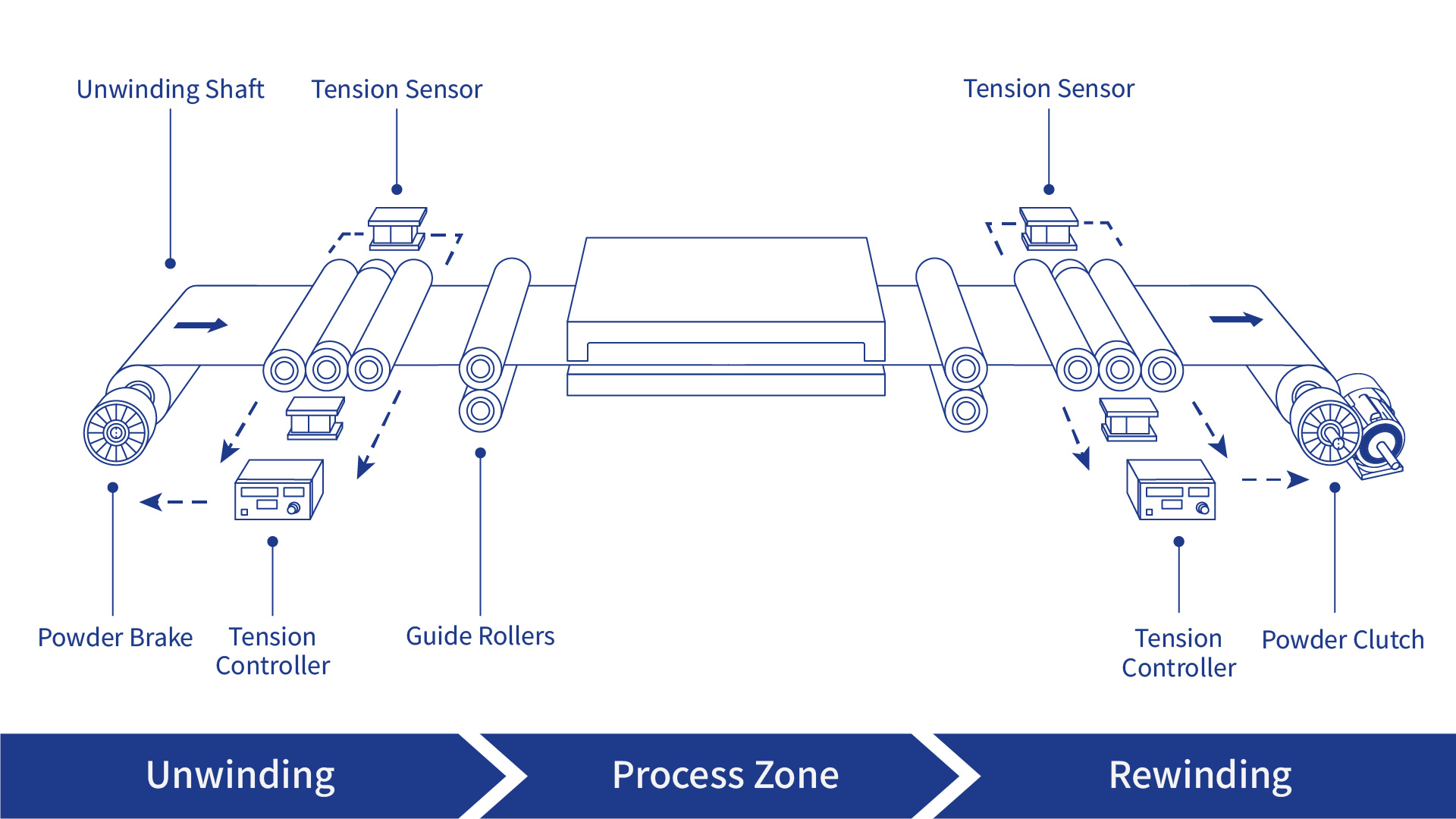
System Components
Magnetic powder brake & clutch
Torque generation
Tension controller
Signal processing and compensation
Tension sensor
Feedback measurement
Unwinding shaft and guide rollers
Web transport and path stabilization
Control Logic
Measured tension is continuously monitored and compared with the target setpoint.
The controller calculates deviation between actual tension and desired value in real time.
Compensation is applied based on roll diameter variation.
Additional compensation is applied for line speed changes and process dynamics.
Output current is adjusted accordingly to regulate braking torque.
A closed-loop control system is formed to maintain stable and consistent tension.
Three-Level Tension Control Solutions for Rewinding & Unwinding
Rewinding and unwinding applications require different levels of tension control depending on line speed, substrate sensitivity, roll diameter range, and finished roll quality targets.
HELISTAR structures rewinding and unwinding solutions into three practical levels so OEM buyers and factory managers can choose the right balance of system capability, integration depth, and investment value.
This system-level approach ensures that the brake, controller, sensing method, and roll handling dynamics work together to improve web stability and roll consistency rather than relying on isolated component changes.
Entry-Level Tension Control for Standard Rewinding and Unwinding Systems
Best for
Standard rewinding and unwinding systems with relatively stable operating conditions, moderate speed, and straightforward web handling requirements. Also suitable for operations currently relying on manual tension adjustment or operator monitoring to maintain roll consistency, and looking to establish a more reliable process baseline at reasonable integration cost.
Configuration
- Magnetic powder brake for stable unwinding torque
- Basic tension controller or manual adjustment interface
- Standard guide roller layout for web transport stability
- Suitable for simpler open-loop or semi-adjusted operation
Result
Provides a practical and cost-effective foundation for stable web feeding, improved basic roll formation, and reduced tension-related defects in standard roll handling applications.

Closed-Loop Tension Control for Better Web and Roll Stability
Best for
Higher-speed rewinding and unwinding lines that require stronger control of web stability, roll consistency, feeding smoothness, and waste reduction across changing roll diameter and speed conditions. Also suitable for operations where finished roll quality varies between operators or shifts, and where reducing reliance on individual operator monitoring is a production management priority.
Configuration
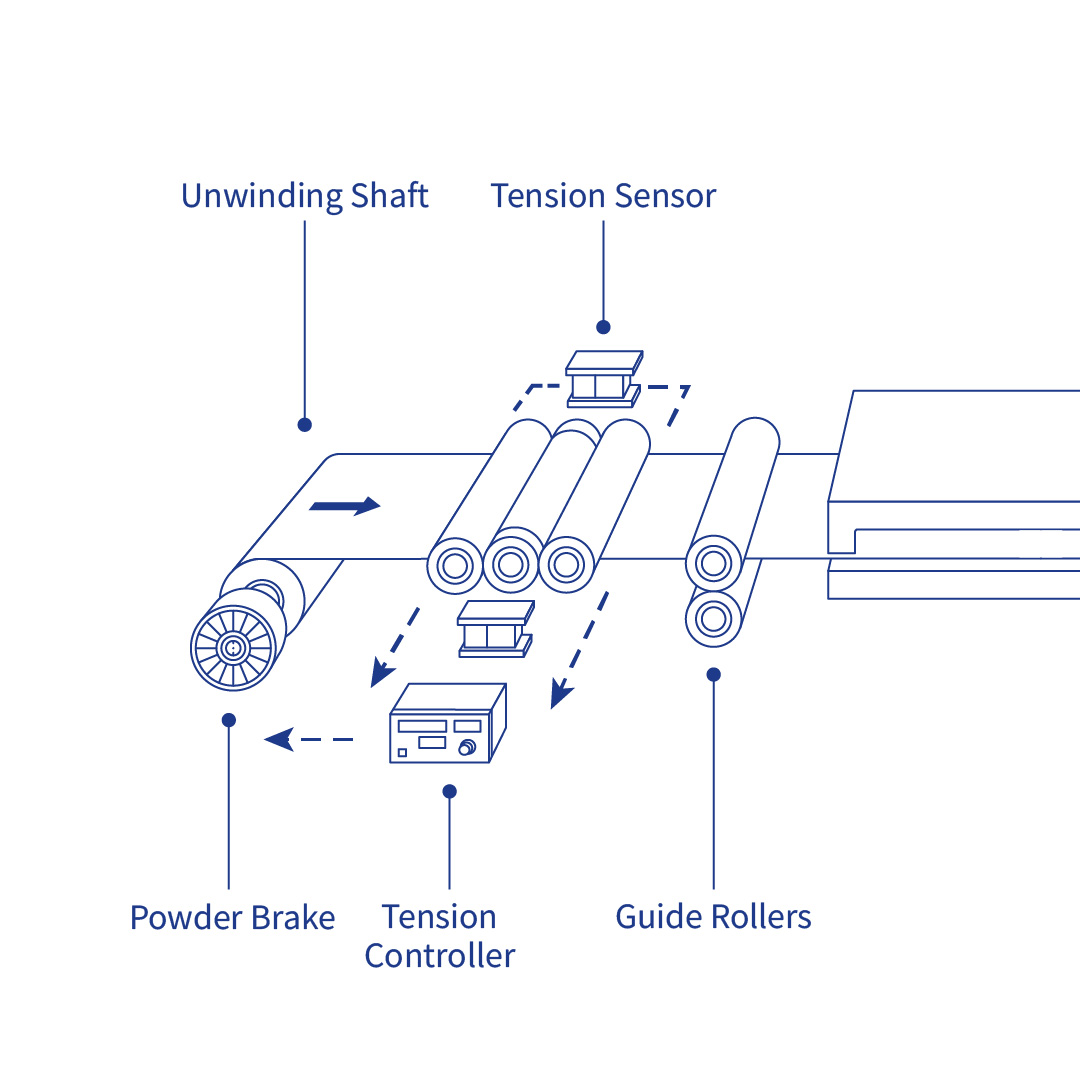
- Magnetic powder brake with real-time torque adjustment
- Tension controller with closed-loop feedback capability
- Tension sensor for continuous web tension monitoring
- Optimized unwinding and guide roller arrangement for improved web stability
Result
Delivers more stable web transport, better roll formation repeatability, improved feeding consistency, and lower startup and transition waste across a broader range of materials and operating conditions.
Integrated Tension Management for High-Performance Roll Handling Systems
Best for
High-speed or high-value roll handling systems that require tighter coordination between unwinding, web transport, rewind buildup, and downstream process stability, along with stronger repeatability across multiple materials and job types. Suitable for operations managing multiple materials or running the same roll specification across different machines or production periods, where consistent roll quality regardless of operator or shift is a key management requirement.
Configuration
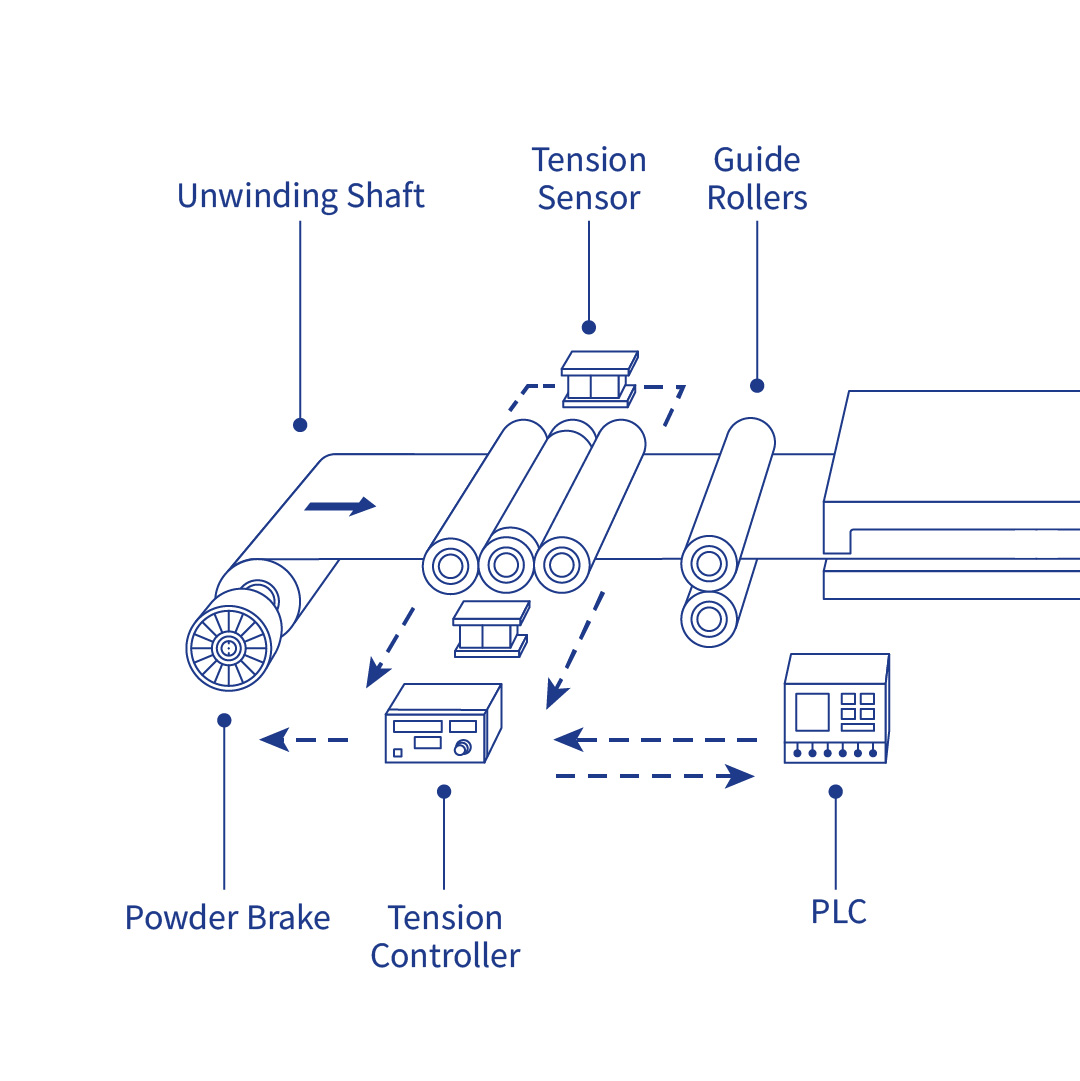
- Magnetic powder brake with real-time torque adjustment
- Magnetic powder clutch with real-time torque adjustment
- Advanced tension controller integrated with broader line control logic
- Tension sensing strategy configured for higher process sensitivity
- System-level optimization across unwinding, web transport, rewinding, and downstream feeding behavior
Result
Enables stronger process stability, more predictable roll quality, faster setup optimization, and higher production confidence in demanding rewinding and unwinding environments where consistency and control are critical.
Typical Applications
HELISTAR rewinding and unwinding solutions are suitable for roll handling processes where stable tension directly affects web transport, roll formation, downstream process consistency, and overall production reliability.
Standalone Rewinding Systems
Maintain stable tension throughout the rewind process to support more uniform roll hardness, cleaner roll edges, and improved finished roll structure.
Unwinding Units in Roll-to-Roll Production Lines
Provide smoother material release and more stable feeding into downstream equipment such as printing, coating, laminating, and slitting machines.
Film, Paper, Foil, and Laminate Web Handling
Support precision tension control for materials that are sensitive to stretching, slack, wrinkling, or edge instability.
High-Speed Converting and Roll Transfer Systems
Improve process repeatability and web stability in faster applications where diameter change and speed transitions occur frequently.
What You Gain with HELISTAR Solutions
A properly integrated tension control solution improves more than roll braking behavior. It strengthens web stability, protects finished roll quality, and creates measurable value for both machine builders and production teams.
More Stable Web Handling
Stable tension helps the material move more consistently through unwinding and rewinding sections, reducing web fluctuation and improving downstream process support.
Better Finished Roll Quality
Controlled tension behavior contributes to tighter, more uniform rewind rolls with fewer edge defects, telescoping issues, and hardness variations.
Lower Waste and Less Operator Intervention
By improving tension consistency throughout the roll cycle, the system helps reduce startup scrap, web defects, and line disturbances — while also reducing the need for operators to manually monitor and compensate for tension changes as roll diameter varies.
Improved Speed Stability and Production Efficiency
A more stable unwind and rewind process allows the line to operate with better consistency at productive speeds across changing roll conditions.
Reduced Operator Monitoring Dependency and More Consistent Roll-to-Roll Output
A system-level architecture automatically compensates for roll diameter change and process variation — reducing reliance on experienced operators to monitor and manually adjust tension throughout the cycle, and making finished roll quality more consistent across different operators, shifts, and production runs.
Application Example
Case
A flexible material converter operating a high-speed rewinding system needed to improve finished roll consistency and reduce web instability during roll buildup and speed transitions.
Challenge
The existing system produced tension fluctuation as roll diameter changed, especially during acceleration and deceleration. This caused loose winding, intermittent wrinkling, and inconsistent roll hardness, which increased waste and reduced process confidence.
Solution
HELISTAR implemented a closed-loop tension control configuration using a magnetic powder brake, tension controller, and tension sensor, with control tuning matched to the material characteristics, roll size range, and production speed. The system was configured to compensate for diameter variation and stabilize braking torque in real time.
Result
The line achieved more stable web transport, improved roll formation, and better finished roll consistency. Waste during startup and speed transitions was reduced, and roll quality became more repeatable across production runs and operators — reducing the need for manual tension monitoring and adjustment as roll diameter changed throughout the cycle.
Why HELISTAR for Rewinding & Unwinding Tension Control
HELISTAR combines component engineering expertise with practical understanding of web handling, roll formation, and downstream process stability.
Our solutions are built around stable torque output, reliable feedback control, and application-focused integration support that helps customers move from isolated component selection toward more effective system design.
With extensive experience in magnetic powder and electromagnetic clutch/brake technology, we support OEM buyers and factory managers with durable, production-oriented solutions that deliver clear operational value.
Years focused on tension
Global machinery partners
Inspection commitment
Application industries
FAQ
These questions reflect common concerns from OEM buyers and factory managers evaluating tension control solutions for rewinding and unwinding systems. The answers focus on system-level value, implementation priorities, and practical production performance.
Because web stability and roll quality depend on how the brake, controller, sensor, shaft mechanics, and roll buildup behavior work together. A single component upgrade may not solve loose winding, wrinkling, or unstable feeding. A system-level approach provides stronger and more repeatable production results.
It provides smooth and controllable braking torque, helping maintain more stable web tension as roll diameter changes. For OEM builders, this improves machine platform reliability. For factory managers, it supports better roll consistency, lower waste, and more stable production performance.
Yes. One of the core operational benefits of a closed-loop tension control system is that it automatically compensates for roll diameter change and process variation in real time — without requiring operators to manually track and adjust braking behavior as the roll builds or depletes. This reduces reliance on experienced personnel to maintain roll quality through the cycle, makes production results more consistent across operators and shifts, and lowers the risk of roll quality variation when less experienced personnel are running the machine.
Yes. The same system architecture can be adapted for standalone rewinders, unwind units, and integrated roll-to-roll production systems. Final configuration depends on material properties, web width, line speed, torque demand, and required roll quality.
A properly matched tension control system reduces startup scrap, improves process repeatability, and makes the line less sensitive to speed changes and roll diameter variation. This supports better uptime, more stable product quality, and easier production management across multiple jobs and material types.
Recommended Products for Rewinding & Unwinding Applications
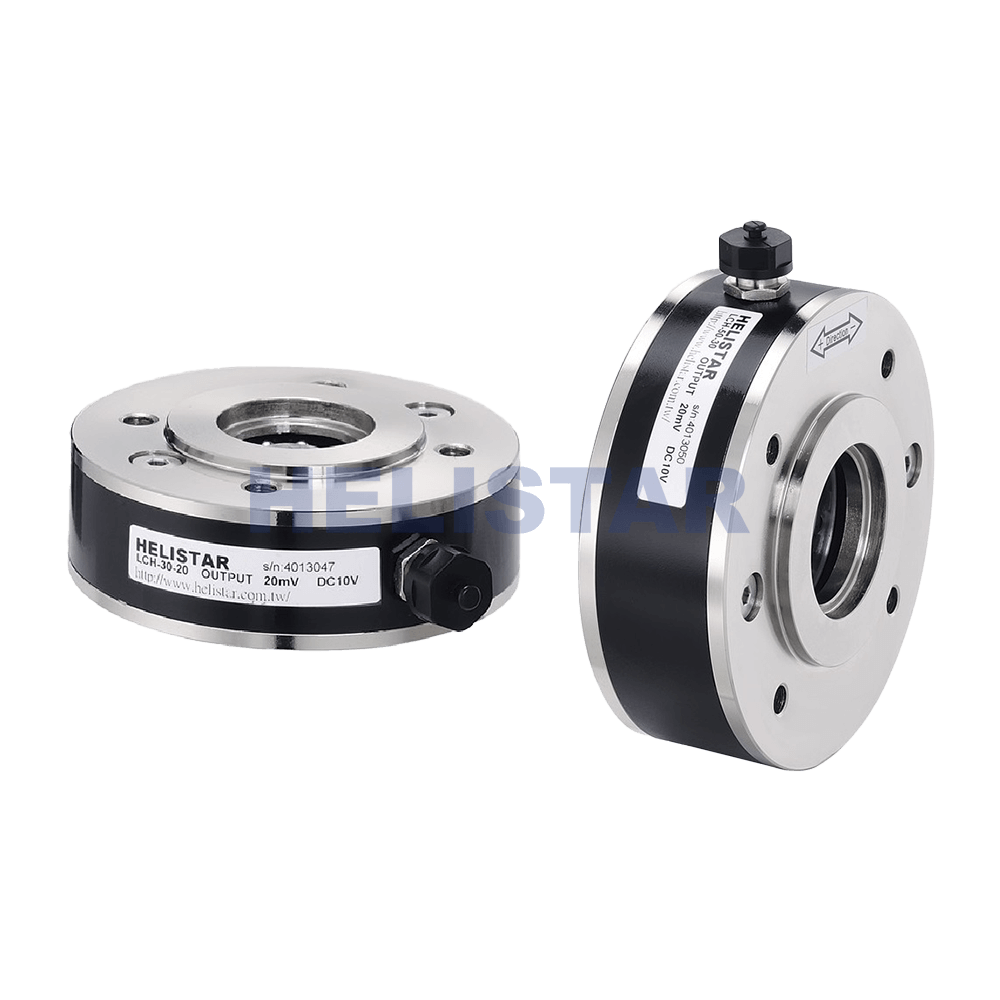
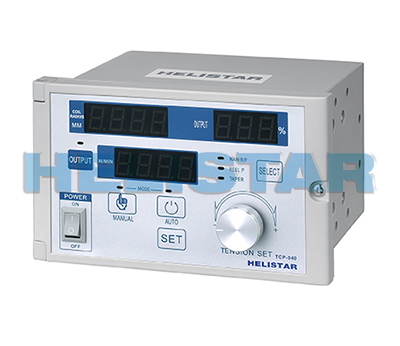
Recommended product groups for rewinding and unwinding systems typically include magnetic powder brakes for unwinding torque control, tension controllers for real-time adjustment, and tension sensors for feedback-based stability.
Magnetic Powder Brakes
Designed for continuous slip operation with excellent heat dissipation


Magnetic Powder Clutchs
Designed for smooth torque transmission with stable control and responsive engagement


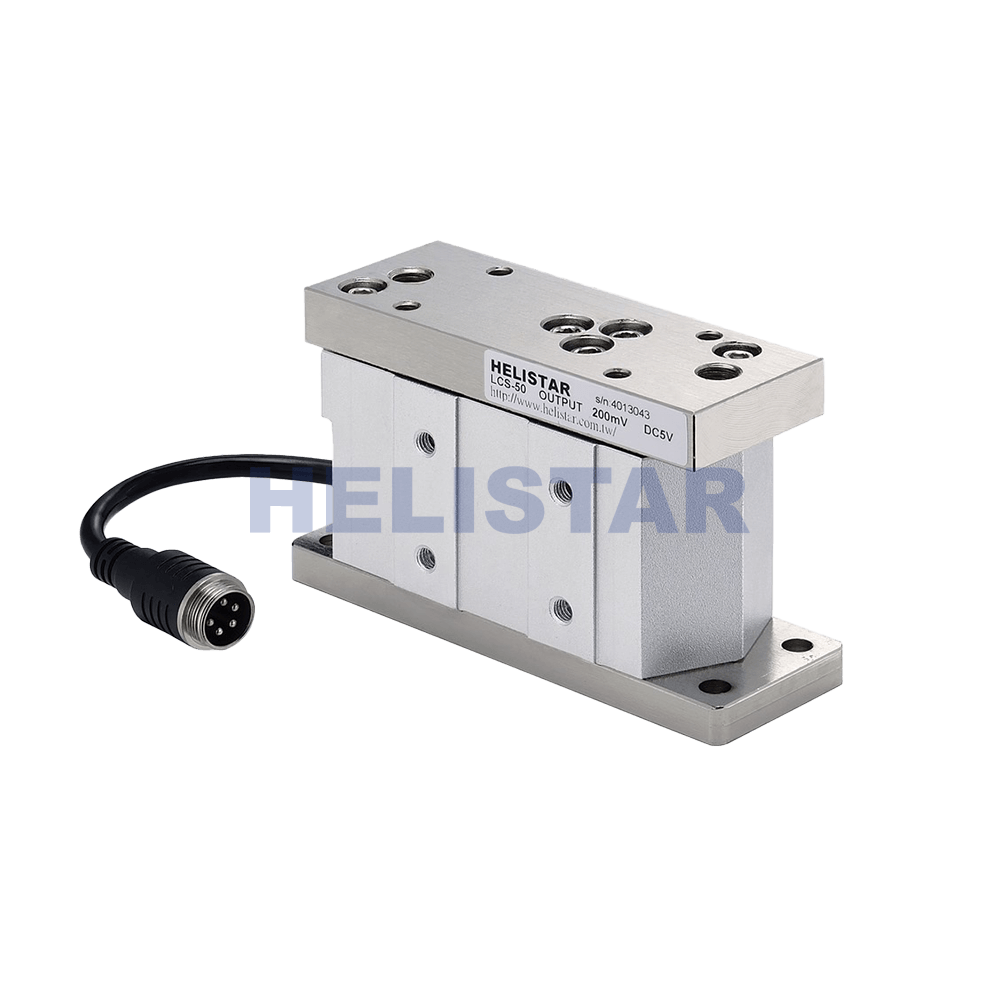
Tension Sensors
High-sensitivity feedback for closed-loop control
Tension Controllers
Diameter calculation and taper tension control



Related Insights
Explore additional insights on manufacturing excellence and component design

Ready to optimize your line
Request our catalog or speak with our technical team about your application requirements.