1) The Problem You Need to Solve: Why Does Unstable Tension Lead Directly to Yield Loss and Downtime?
In continuous processes such as roll-to-roll (roll-to-roll, R2R), unwinding and rewinding, slitting, coating, laminating, and printing, fluctuations in the tension of films, paper, foil, nonwovens, and film composites can quickly develop into:
- Wrinkles, bubbles, and poor lamination: Tension fluctuations cause local stretching or compression.
- Web wandering and misalignment: Inconsistent guide-roller friction and tension cause edge drift.
- Web breaks during startup and slack at shutdown: Torque or tension compensation is insufficient during acceleration and deceleration.
- Uneven rewind edges, inner-roll wrinkles, and inconsistent winding tightness: The rewind tension strategy is unsuitable or roll-diameter compensation is inaccurate.
The purpose of a complete tension control system is straightforward: keep web tension within a settable, repeatable, and traceable range, while maintaining stable operation as roll diameter, speed, material batches, and environmental conditions change.
In one sentence: A complete tension control system integrates controllable torque (brake/clutch) + measurable feedback (sensing) + an adjustable control strategy (tension controller).
2) Why Is a Magnetic Powder Brake + Magnetic Powder Clutch + Tension Controller Suitable for Many Roll-to-Roll Lines?
At the unwind and rewind ends of many production lines, the torque components need to provide smooth, adjustable torque and support prolonged slip operation. A practical configuration uses:
- Unwind end: magnetic powder brake
- Rewind end: magnetic powder clutch
- Core control: tension controller, paired with feedback from a load cell or dancer roller
This configuration can often balance cost, integration time, and stability because:
- Smooth torque output and good control linearity: These help convert torque into repeatable web tension.
- Tolerance of process disturbances: Examples include splices, variations in material thickness, and changes in friction coefficient.
- Ease of standardization: Control signals, wiring, parameter logic, and maintenance practices can more readily become standard operating procedures (SOPs).
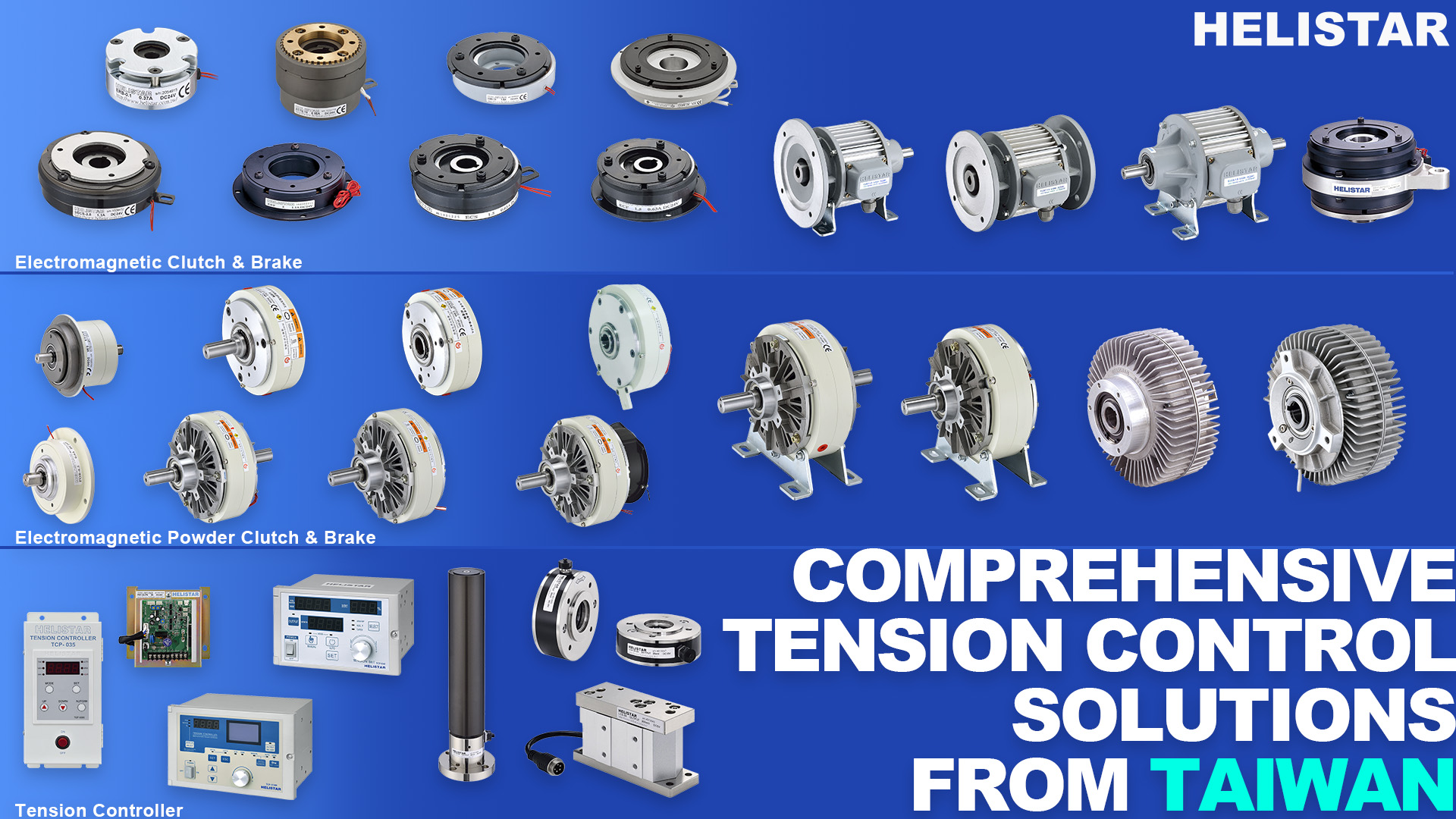
Related products for further evaluation: PLB/POC (magnetic powder brake and clutch series), TCP-818D (tension controller), and PSV (peripherals and integration requirements determined by the application).
3) Match the Scenario: Classify Your Line First to Select Tension Control Faster and Manage Risk
Installing components alone does not guarantee stable tension. First determine which of the following needs describes your line.
4) Selection Criteria: Turn Requirements into Engineering Specifications
For a complete tension control system, organize the specifications into three areas: torque components, the controller, and measurement feedback and wiring.
4.1 Start with the Core Relationship: Tension, Torque, and Roll Diameter
The basic relationship is:
F ≈ T / R
- F: Web tension (N)
- T: Torque (N·m)
- R: Effective radius (m); if roll diameter is D, then R = D / 2
In practical terms, a larger roll diameter requires more torque to maintain the same tension; a smaller diameter requires less torque. The changing roll diameter is one of the most common sources of unstable tension.
4.2 Selecting a Magnetic Powder Brake (Unwind End): Three Essential Questions
- Does the torque range cover the largest roll diameter and acceleration/deceleration peaks?
- Estimation approach: Peak demand often occurs with a larger roll diameter together with acceleration disturbances and stopping inertia.
- Suggested allowance: 1.3–2.0 times the estimated requirement, adjusted for material inertia, start/stop frequency, and material sensitivity.
- Are heat dissipation and continuous-slip capacity sufficient?
The unwind brake often operates in slip, generating heat continuously. Check:
- Whether the installation space supports convective cooling
- Whether temperature rise during continuous operation remains within specification
- Whether oil or water mist, elevated ambient temperature, or other site conditions are present
- Can mechanical installation quality, concentricity, and bearing condition be controlled?
Poor concentricity can destabilize torque output. It may ultimately appear as periodic rises and falls in tension, increasing the risk of wrinkles and web wandering.
4.3 Selecting a Magnetic Powder Clutch (Rewind End): Consider the Winding Strategy as Well as Torque
- Low-speed stability and torque linearity
Rewinding is often most sensitive during low-speed positioning, splicing, and trial runs. Unstable low-speed motion can directly affect roll edges and tension. - Permissible slip, service life, and temperature-rise assessment
The rewind clutch may also operate in slip for long periods. Treat heat and wear as selection criteria rather than later maintenance issues. - Need for a tension profile and roll-diameter compensation
If the outer layers must not be too tight, the roll edges must remain even, or the material must not stretch excessively, one fixed tension setpoint may be insufficient. The tension controller must provide a staged or profiled rewind strategy.
4.4 Selecting a Tension Controller: Can It Stabilize, Be Tuned, and Be Replicated?
The tension controller determines whether stable tension can become a repeatable production capability. Evaluate:
- Feedback support: Load cell or dancer roller (at least one), and whether flexible switching is required
- Output type: Stable control output, commonly current output, matched to the magnetic powder brake and clutch
- Acceleration/deceleration handling: Ramp limits, compensation for inertia disturbances, and start/stop logic to prevent slack or web breaks
- Recipe parameter management: Switching between materials or processes with one selection to reduce reliance on an experienced operator’s manual adjustments
- Filtering and interference resistance: Suppression of measurement fluctuations caused by guide-roller vibration and electromagnetic noise so the controller does not act on false feedback
5) Common Mistakes and Site Considerations: Why Tuning Alone Often Cannot Stabilize the Line
5.1 Treating Open-Loop Control as Closed-Loop Control: Tension Drifts as Roll Diameter Changes
A fixed torque setting or simple proportional compensation can drift as material friction, roll diameter, and speed change. If stable yield is the goal, consider closed-loop control with load-cell or dancer-roller feedback in critical zones.
5.2 Improper Load-Cell Installation and Wiring: Measurement Drift, Signal Noise, and Control Oscillation
- Unshielded signal cables, signal cables routed parallel to power cables, or grounding that creates multiple return paths
- Missing calibration steps for zero, full scale, and signal direction
The result is that the controller “sees” fluctuating tension when the signal itself is fluctuating.
5.3 Ignoring Heat: Prolonged Slip Causes Thermal Torque Drift and Inconsistent Performance
Magnetic powder brakes and clutches generate heat continuously during slip. Temperature rise can change torque characteristics and reduce service life. Include:
- Duty cycle (Duty cycle)
- Maximum web speed and prolonged operating conditions
- Installation and cooling conditions
5.4 Inconsistent Mechanical Resistance: Control Cannot Compensate for a Binding Mechanism
Differences in guide-roller bearing resistance, web wrap angle, and friction coefficient create disturbances that are difficult to control. Inspect mechanical resistance, concentricity, backlash, and inertia before optimizing controller parameters.
5.5 Missing Soft Start/Stop Strategy: Web Breaks at Startup and Slack at Shutdown
- Startup: The traction mechanism has no soft start or torque rises too quickly → the web is pulled suddenly.
- Shutdown: The controller does not maintain tension or torque falls too quickly → the web rebounds and becomes slack.
Controller ramp settings, hold time, and abnormal-stop strategy can often help more than repeatedly adjusting PID parameters.
6) Recommended Implementation Sequence: Reduce Trial and Error
If the goal is to reach stable production quickly, proceed in this order:
- Define the tension window: Permissible material tension range and required stability in critical process zones
- Confirm roll-diameter range and web speed: Maximum/minimum diameters, maximum web speed, and start/stop frequency
- Select the architecture: Magnetic powder brake for unwinding, magnetic powder clutch for rewinding, and a decision on closed-loop control
- Define the controller strategy: Feedback type, acceleration/deceleration logic, material recipes, and tension profiles
- Specify wiring and interference controls: Shielding, grounding, terminals, and separation of power and signal cables
- Verify in trial operation: Starts and stops, acceleration and deceleration, splice stability, maximum/minimum diameters, and temperature rise during prolonged operation